Where should the joints go in an L-shaped or U-shaped kitchen? Explore four worktop joint layouts, how they affect the ogee profile, and what needs to be checked before fabrication.
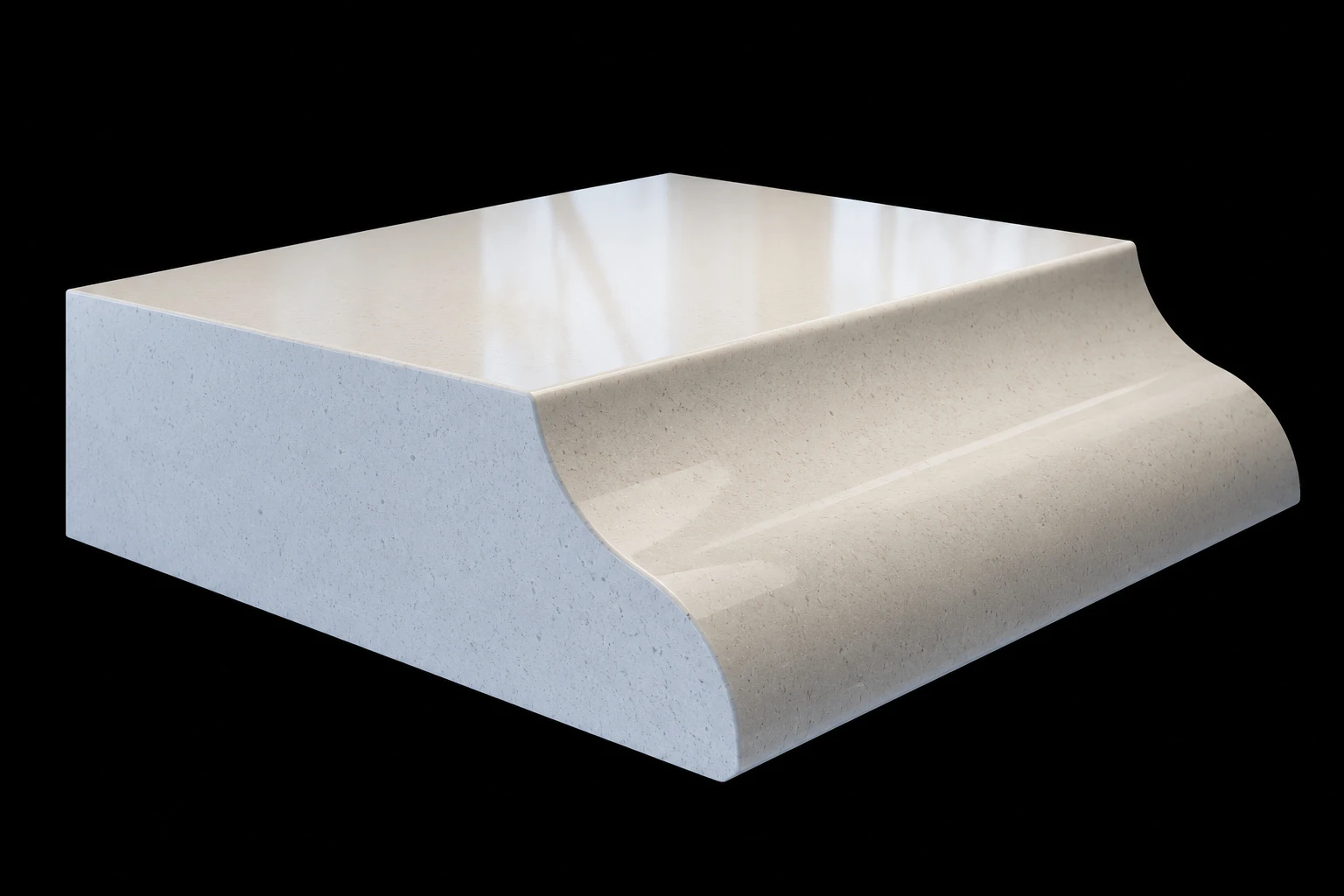
Ogee edge profile shown on a light-coloured stone sample. The diagrams below explain possible worktop joint positions; this image does not show a joint.
Understanding the finish
Why are ogee corner joints different?
An ogee edge has a flowing decorative shape, generally made up of concave and convex curves. At an ordinary straight seam, both pieces must line up on the worktop surface and along the full shaped edge.
At an internal kitchen corner, the issue is more noticeable: the ogee needs to look consistent as it changes direction. Simply joining two square-cut profiles may leave an abrupt or misaligned transition.
The correct detail depends on the worktop material, available equipment, joint position and the chosen profile. A neat seam is possible, but it should never be promised as completely invisible.
Important distinction: A mitre through the ogee nose is not necessarily the same thing as a 45° joint through the entire worktop. Stone Federation GB illustrates a mitre through a bullnose profile, but that drawing is not a confirmed ogee fabrication detail. The diagrams below are explanatory layouts, not cutting templates.
Corner seam layouts
Four ways to position joints in a U-shaped worktop
These top-view diagrams show the back run and two returns of a U-shaped kitchen. The same corner-joint principles can be considered for an L-shaped worktop with one return.
Worktop surfaceExposed ogee edgeProposed joint
OPTION 01 · Straight joints at both corners
Two straight corner joints
Two return pieces meet the back worktop. The seams come to the profiled inner corners, so the ogee ends need careful matching. Where appropriate, the local profile or nose can be mitred while the worktop seam remains straight.
Possible advantage: Straight lengths suit an automatic edge-profile polisher; profile transitions require a carefully planned test fit.
Consideration: The joins remain visible at the corners, especially on patterned surfaces.
OPTION 02 · Diagonal joints through the corners
Diagonal worktop corner joints
Each return meets the back piece along a diagonal joint through the corner. This is a full worktop seam, not simply a mitre through the ogee nose.
Possible advantage: A different cutting layout may be useful in a particular design or slab plan.
Consideration: Diagonal seams still show on the top surface and must be aligned at the profiled edges.
OPTION 03 · One joint across the back run
Joint-free corners with one centre seam
Both inner corners are retained as part of the stone pieces. A single seam crosses the rear run between the corners.
Possible advantage: There is no visible joint exactly at either ogee corner.
Consideration: The ogee must be formed around each one-piece inner corner by suitable hand finishing or CNC work; slab geometry, internal radii and handling need checking.
OPTION 04 · Joints along the side runs
Joint-free corners in a large U-shaped centre
A large central section retains both inner corners. Two seams are positioned on the straight side returns, away from the turns.
Possible advantage: The decorative corners are not interrupted by worktop seams.
Consideration: The central section may be impractical to cut, move or install and the ogee corners still require specialist finishing.
Drawings are not to scale. Actual internal corner radii, seams, supports, cut-outs, slab yield and safe handling must be designed for the specific worktop and manufacturer.
Choosing the joint location
Which option gives the most continuous ogee edge?
The preferred layout depends on what you are trying to minimise: the visual seam at the corner, the amount of special corner machining, or the size and shape of the worktop pieces.
For straight-line edge polishing
Option 1 is a sensible starting layout to discuss because straight exposed edges can be prepared with an automatic profile polisher. The ogee junctions at both corners still need a suitable end detail, precise alignment and workshop verification.
For joint-free corners
Option 3 avoids seams at the two corners. However, the continuous ogee profile must be formed around those solid internal corners, which may require hand work or CNC capability and an appropriate slab cutting plan.
Layout
Where the seam appears
Main fabrication consideration
1. Straight corner joints
At both ogee corners
Matching the profiled ends and fitting the seams
2. Diagonal corner joints
Diagonally across each corner
Cutting layout, vein matching and ogee transitions
3. One back-run joint
In the middle of the rear run
Forming the ogee around solid internal corners
4. Two side-run joints
Along the straight returns
Large central piece plus solid-corner profiling
Before cutting the stone
What needs checking during templating and fabrication?
1. Confirm the seam positions
Agree the U-shaped layout, exposed edges, cut-outs and joint positions at templating stage rather than choosing seams only after cutting begins.
2. Check the selected material
Follow the specific manufacturer's guidance for edge profiles, joints, internal corner radii, support and handling. Guidance for one quartz, granite or porcelain product should not be transferred automatically to another.
3. Plan the ogee transition
Check how the profile will meet at each joined corner—or how a joint-free corner will be finished. Matching profile geometry and polish is as important as aligning the top surface.
4. Match the equipment to the detail
A straight-line edge polisher machines straight runs. A solid corner may require skilled hand finishing or suitable CNC tooling, while mitred profile ends need a controlled finish and test fit.
5. Consider 20 mm and 30 mm separately
Both thicknesses may offer ogee options, but the available curve and fabrication method depend on the chosen material and tooling. Confirm the approved profile before quoting or cutting.
6. Set realistic expectations
Slab veining, colour, adhesive, lighting and the ogee curve can all affect how noticeable the final seam looks. Show a sample or corner mock-up where the finish is critical.
Questions & answers
Ogee edge joint FAQs
Can an ogee worktop have an invisible joint?
There is no reliable way to guarantee an invisible joint. Accurate fabrication, polish and colour-matched adhesive can make a seam less noticeable, but the stone pattern and curved profile can still reveal it.
Is a 45-degree corner joint necessary for an ogee edge?
No. A diagonal seam through the full worktop is only one layout. Another approach uses a straight worktop seam with a specially finished meeting point at the profiled nose. The suitability of either must be assessed for the actual worktop.
Can an automatic edge polisher finish an ogee around a solid corner?
A conventional straight-line edge polisher works on straight runs; it does not automatically carry the cutter around an internal 90-degree corner. Solid corners may require other equipment or qualified hand finishing.
Is an ogee edge possible on 20 mm and 30 mm worktops?
It can be available on both. Cosentino's Silestone documentation lists ogee among its edge options, but the exact geometry depends on the manufacturer and thickness. Always confirm feasibility for the actual slab and tooling.
Which arrangement is best for a U-shaped kitchen?
There is no universal answer. Straight corner joints may simplify straight-line edge machining, while solid corners can avoid corner seams but require additional profiling and careful handling. Slab size, supports and cut-outs can change the preferred layout.
Further technical reading
Manufacturer and industry guidance
These references inform the general worktop fabrication principles. They do not establish a universal ogee corner-joint specification.
For other surfaces, consult the appropriate manufacturer rather than treating Silestone instructions as applicable to all quartz, natural stone or sintered-stone products.
Planning an ogee-edge kitchen worktop?
Send London Kitchen Worktops your kitchen measurements or plan, chosen stone and preferred edge detail. We can discuss possible joint locations and confirm what is achievable before the worktop is fabricated.